
We are back with another Godzilla retrospective. This time, we take a look at what I’d argue is the greatest kaiju film of all time and the end of Godzilla’s Heisei era, Godzilla vs. Destoroyah (1995). Where Godzilla: Final Wars was an ending and celebration of the franchise, Godzilla vs. Destoroyah is a sad, somber farewell to the King of the Monsters. Strap in folks, this is a long one.

Many are quick to assume Godzilla films are cheesy monster movies with boring human characters, corny rubber suits, and cheap cardboard miniatures. To them I say- Go Fuck Yourself. While the Heisei era isn’t my favorite in the Godzilla canon, it holds one of the singular most powerful showcases of what a monster movie can be as its crown jewel. The Heisei era was Toho’s attempt at building a cohesive Godzilla canon, centered around one of the best human characters in in the franchise, everyone’s favorite telepath, Miki Saegusa (portrayed by Megumi Odaka). Miki shares a psychic bond with Godzilla and his adopted son, Junior, and as played an impactful role in nearly every Heisei Godzilla film. Wow! We are finally going to get an article where I discuss the plot of a movie in-depth. Spoilers ahead.

Throughout this era, we see this iteration of Godzilla fight an array of classic and new foes, from fan favorites like Rodan, Mechagodzilla, and Mothra, to new monsters we now consider classic like SpaceGodzilla, Biollante and of course, Destoroyah. Since these all share the same continuity, we also see an updated version of a controversial character, Minilla, now named Godzilla Junior, grow from a new hatchling to the empowered Godzilla we see at the end of vs. Destoroyah over the course of the series. When it came to Godzilla doing silly things he was known for in the Showa Era like playing soccer with Kamacuras or literally taking flight to defeat Hedorah, Toho was much more restrained with Godzilla’s reactions and emotions in the Heisei series. By the time we get to vs. Destoroyah, we the audience have seen Godzilla himself mature over time and settle into his role as King of the Monsters, and serves well as an adoptive father to Junior. Going into this film, which was marketed with the tagline “GODZILLA DIES”, Toho was able to do something completely new for the heart of a Godzilla film. It was such a powerful tagline that even the American media covered the film’s release on primetime in the 1990s. See below:
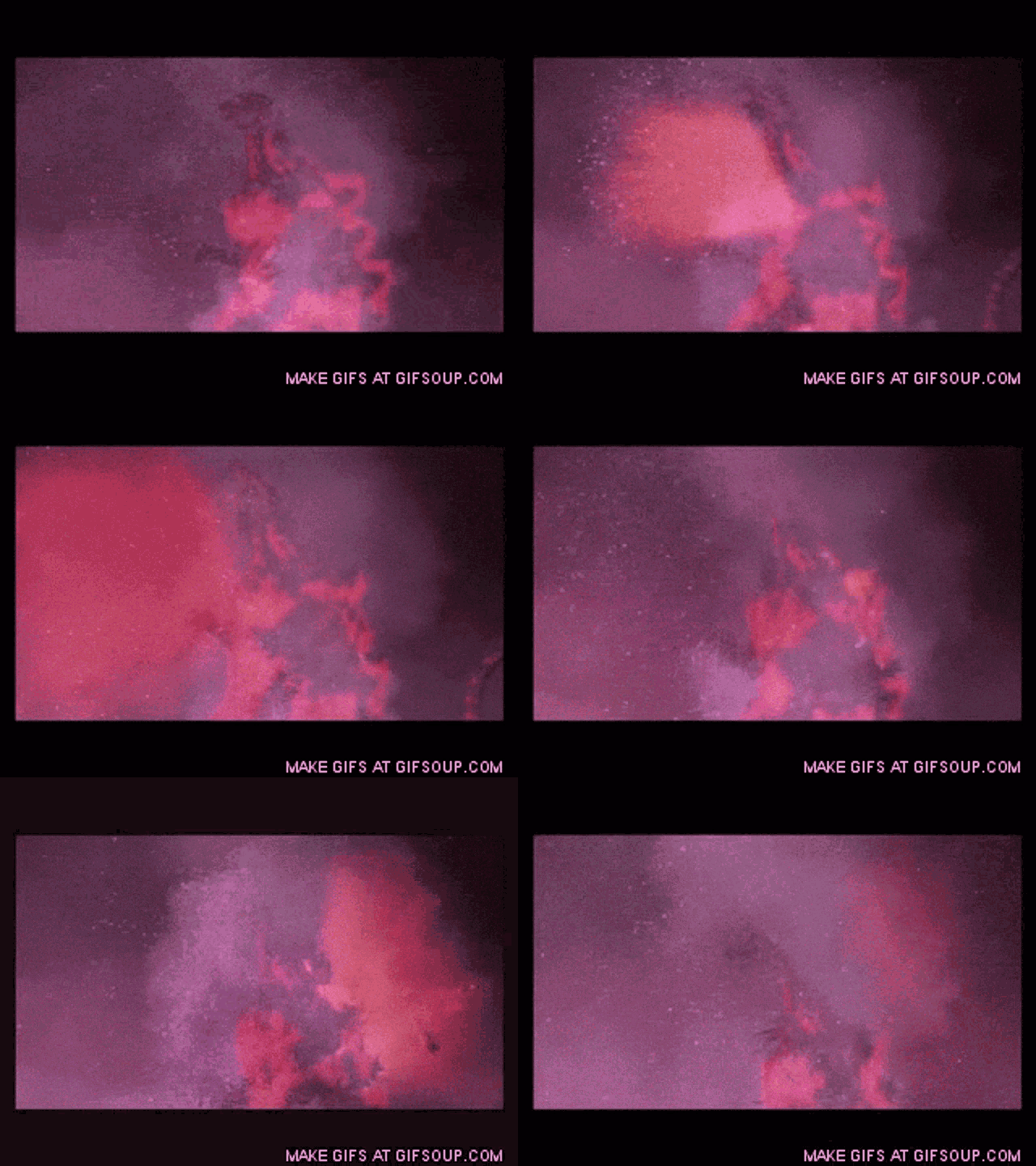
The film begins with Godzilla rampaging throughout Hong Kong, with a new and distinct Burning form. This iconic look is now known as Burning Godzilla. The Japanese Self Defense Force scrambles to figure out what went wrong to cause such an attack, only for Miki to find that Birth Island, where Godzilla and Junior resided, had been destroyed by a burst of nuclear fission. During their scramble to retrieve information about what is causing Godzilla’s burning form, the JSDF and UNGCC come across a university thesis titled “A Private Consideration of Godzilla’s Structure”, in which student Kenichi Yamane (played by Yasufumi Hayashi) hypothesizes that Godzilla’s energy source functions similarly to a nuclear reactor. In the film, him and the JSDF/UNGCC come to the conclusion that Godzilla’s burning form is a result of an internal meltdown reaction. This was caused by Godzilla absorbing too much nuclear radiation after a volcanic eruption combined with a deposit of uranium on Birth Island. Kenichi theorizes that once Godzilla reaches 1200 °C, he will reach a critical point so catastrophic that it would simultaneously burn a hole through the center of the planet while vaporizing our atmosphere. This theory is accompanied by one of the most haunting visuals in the entire franchise: Godzilla’s (theoretical) meltdown as viewed from space. The implications from this image alone are terrifying. Pardon the crappy image quality, I couldn’t find an HD image of this exact moment.

While the JSDF and United Nations Godzilla Countermeasure Center are working together to find a way to prevent Godzilla’s meltdown, a construction project in Tokyo Bay leads to the awakening of mutated pre-Cambrian organisms, dubbed as The Destoroyah. It is discovered that this mutation was caused by the use of the Oxygen Destroyer, the device that kills the original Godzilla in 1954. This is where one of the main points of tragedy stems from in the film. Mankind’s answer to destroy an abomination created by nuclear weapons has now become an abomination in its own right. These mini-Destoroyah’s began wreaking havoc across Tokyo. Meanwhile, the JSDF dispatched the Super X III with a cooling laser, so that it could try and slow down Godzilla’s meltdown. While it doesn’t stop the meltdown completely, it does incapacitate Godzilla for a short time. It also is found that this cooling laser is quite effective against mini-Destoroyah’s as well, until they aggregate into Destoroyah’s second form. After destroying an array of lasers attacking it, Destoroyah morphs into its flying form and leaves.
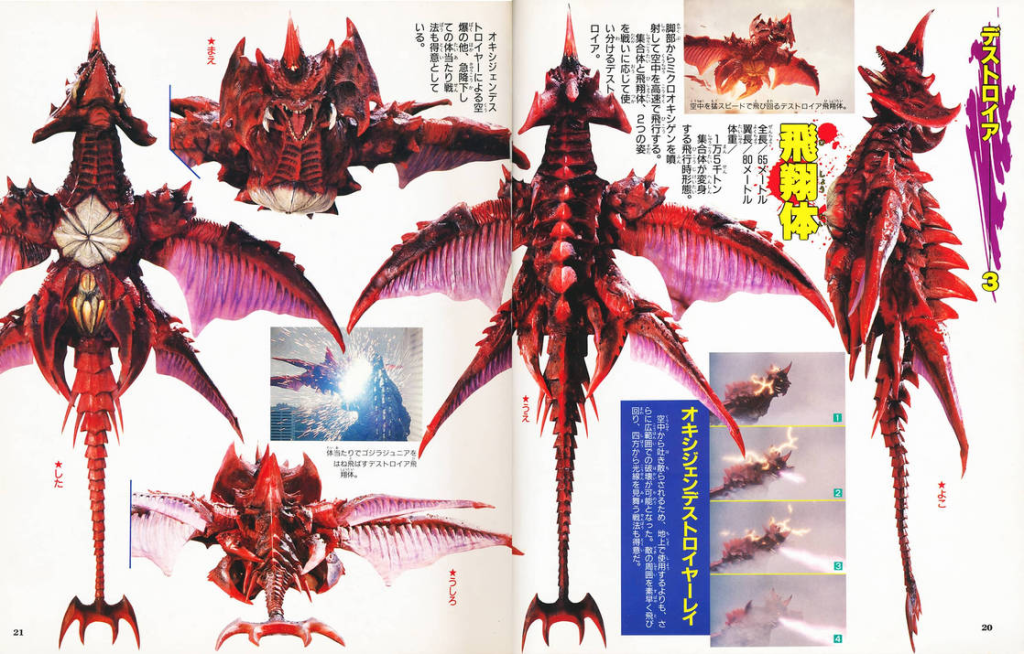
While Destoroyah is on the run and Godzilla is incapacitated, Miki discovers that Junior is still alive and now resembles Godzilla more closely as an adolescent. To much of Miki’s protest, the UNGCC and JSDF form a plan to use Junior as bait in order to lure Godzilla and Destoroyah into battling to prevent Godzilla’s meltdown. Miki eventually agrees to telepathically communicate with Junior, guiding him into Tokyo. Here we see Junior in his first battle: Godzilla Junior vs. Flying Destoroyah. It really feels like a “babys first battle”, and if you have been following the Heisei films up to this point, you can’t help but feel simultaneously proud of him for standing his own ground, and being terrified that he won’t be able to win. There is something so innocent about his first time emerging from the shore. We have seen Godzilla emerge from the shore into a basic industrial area dozens of times before, but for some reason, when it’s Junior, it’s special, almost pure even. As the battle begins, Destoroyah’s flying form rams into Junior, shoots him with his Oxygen Beam, and drops a building on him. Destoroyah spots the helicopter Miki is watching from and makes a B-line to it. Just before impact, Junior emerges from the rubble and shoots him down, rescuing her. When the smoke clears, we see Destoroyah in his smaller aggregate form take on Junior. During their battle, Godzilla emerges and enters Tokyo. It is a brutal fight, and even though Junior gets a few great hits in on him, ultimately, Destoroyah pierces through Juniors chest with a disgusting mouthpiece straight out of Alien (1979). It is a visceral scene, Junior is covered in his own blood and begins violently foaming at the mouth as Destoroyah begins absorbing Juniors energy. All hope for Junior seems lost, before Junior lets out one final massive blast of his atomic breath, sending Destoroyah crashing into a group of buildings. Godzilla emerges from the sea and heads over to inspect the damage. Godzilla and Junior, finally, are reunited.
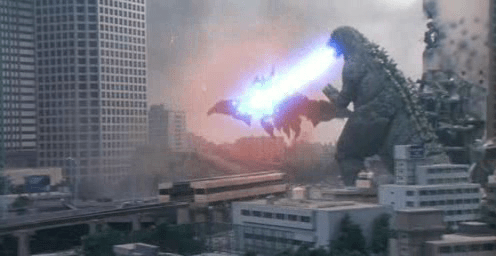
Godzilla’s interactions with Junior are always highlights for me in the Heisei series, mostly because of this movie though. Rather than giving them human-like personalities, the Heisei series leans more into giving the Kaiju more animalistic ways of communicating. They screech at each other a few times from across the Tokyo Airport, and all seems well until Destoroyah emerges in his final form. Destoroyah’s emergence here is downright demonic, emerging through a giant explosion of flames, smoke, and lightning. The stage has been set for Godzilla’s final battle.
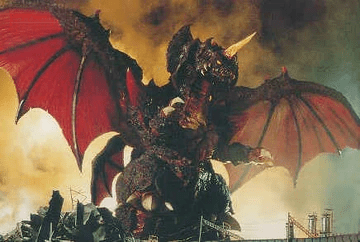
The newly formed Destoroyah rushes a surprised Godzilla and knocks him over, then in the chaos swoops down and grabs Junior by the throat, flying off with him in hand. It is a truly terrifying scene. The first time I watched this, I didn’t know how far Toho would be willing to go. Destoroyah is truly massive compared to Junior, and could easily have bitten his head off. Instead, he drops Junior on a building from, just an eyeball guesstimate- about 300+ feet. This severely wounds Junior, and Destoroyah finishes him off with a final blast of micro-oxygen. It is one of the most shocking kaiju deaths in the franchise. Godzilla, now recovered from the first blow, cries out in anguish at the same time as Miki, who is on the ground with Junior when he takes his final breath. Godzilla has always been psychic-sensitive in the Heisei era, so in my head he senses Juniors death from Mikis cries. Before anyone can have a chance to mourn, however, the final battle begins.

There’s a lot that happens in this battle, from beam battles to Destoroyah’s disgusting yellow goop blood. I won’t describe it all in its gruesome detail, but Godzilla gives everything to defeat Destoroyah, including his life. Before he dies, though, during a moment of respite when we all think Destoroyah is dead, Godzilla makes his way over to Junior, and just stares at him. For one the first time in his history, we see Godzilla grieve. We see him slowly and silently lean closer and closer to Junior’s body, before attempting to give some of his energy to him. When this doesn’t work, Godzilla’s meltdown resumes. He cries out in pain and sorrow for the loss of his child. It’s a tender yet heartbreaking moment that is immediately ruined… by Destoroyah of course. Destoroyah pushes Godzilla to the brink. The meltdown reaches a point so hot that Godzilla’s dorsal fins begin melting off his body. After landing some devastating blows with his atomic breath, Godzilla defeats Destoroyah with help from the JSDF. It’s like Godzilla was holding on til the very last moment before he finally allows himself to melt down fully. As he hits the critical melting point, he is hit by the Super X III’s cryo-beam. During the simultaneous cooling and meltdown process, Godzilla emits levels of radiation so high that it’s visible to the camera. He begins to slowly fall apart, from his dorsal fins to his mouth and face, before letting out a final cry of agony as his chest bursts open and lets out everything he held within him. I’m not ashamed to admit I cry every time at this. That probably doesn’t surprise you given we’re 2000 words into this post, but considering you made it this far, you probably do too.
In case it wasn’t clear, I love this movie. I have it posted as my number 3 on my top 4 on Letterboxd. I feel like this movie isn’t discussed as much as it should be within the Godzilla community, so I wanted to help fix that. I’ll end this with some more metatextual stuff about the movie that I couldn’t fit in the write up.
It is revealed that the university student, Kenichi, is the adopted son of Dr. Yamane from the original 1954 film. Kenichi’s inclusion and the Oxygen Destroyer aren’t the only significant aspects relating the 1954 film. Godzilla vs. Destoroyah also contains the final acting performance of Momoko Koichi, who played Emiko Yamane in both the 1954 film and vs. Destoroyah. In fact, this was also the final Godzilla film to be produced by Tomuyuki Tanaka, and the final Godzilla film to have its score composed by Akira Ifukube. Tanaka had produced every Godzilla film from 1954-1995, and Ifukube composed basically all of the iconic music in the Godzilla franchise that we know today.
Godzilla vs. Destoroyah truly, ceremoniously, marks the end of an era for Godzilla. It was meant to be seen as a “passing of the torch” moment between Toho and Tri-Star, in preparation for the first American take on Godzilla. Thankfully that movie was horrible and we got the epic Millennium era (my personaly favorite) as a result of its failure. If only they knew what was coming down the pipeline in 1998. Maybe we could have gotten a Bagan movie.
Also, If you’re one of those Godzilla fans who say “erm actually the JSDF actually defeats Destoroyah”, come on dude. Get real.
Thanks for reading!
 Anatomy of a Film
Leave a comment